Greg Hayes and Peter Thiel represent two very different paths to influence in American business. Hayes built his reputation through executive leadership in the aerospace and defense sector, while Thiel became known as a technology entrepreneur, investor, and co-founder of companies including PayPal and Palantir. Although their careers have some thematic overlap around technology and national security, they should not be presented as close business partners without documented evidence of a direct relationship.
Who Is Greg Hayes?
Gregory J. Hayes is an American business executive best known for his leadership in the aerospace and defense industry. He became a prominent figure through his career at United Technologies Corporation (UTC) and later served as the chief executive officer of Raytheon Technologies, now known as RTX.
Hayes’ career is closely associated with managing large industrial businesses and navigating major corporate transformations. One of the most important developments during his leadership was the combination of United Technologies and Raytheon, creating a major aerospace and defense company.
His professional experience includes:
- Corporate strategy and executive management
- Aerospace and defense operations
- Large-scale mergers and acquisitions
- Industrial technology
- Global business management
- Leadership of complex multinational organizations
Rather than building a career around startups or venture capital, Hayes followed a traditional corporate leadership path, eventually becoming one of the better-known executives in the aerospace and defense sector.
Who Is Peter Thiel?
Peter Thiel is a German-American entrepreneur, investor, and technology figure whose career has had a major impact on Silicon Valley. He co-founded PayPal, served as its CEO, and later co-founded Palantir Technologies. He is also a partner at Founders Fund and has been an influential early investor in technology companies. Palantir’s official board information identifies Thiel as a co-founder and chairman, while Founders Fund describes him as an entrepreneur and investor.
Thiel’s career is particularly notable because he has operated across several areas:
- Technology entrepreneurship
- Venture capital
- Financial technology
- Data analytics
- Artificial intelligence
- Defense and national security technology
- Startup investing
His role in PayPal helped establish him as a major technology entrepreneur. He later became involved with Palantir, a company focused on software and data platforms used by commercial and government organizations. His investment career also expanded his influence beyond the companies he directly co-founded.
Greg Hayes vs. Peter Thiel: Professional Background
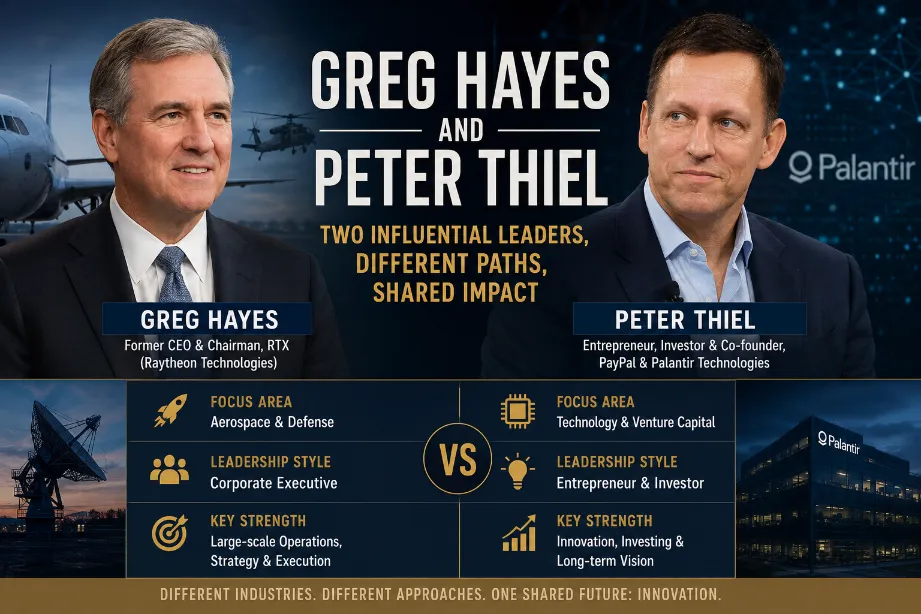
The most obvious difference between the two is their approach to business. Hayes is primarily known as a corporate executive who managed large-scale aerospace and defense operations. Thiel, by contrast, is known for founding technology companies and investing in high-growth businesses.
| Category | Greg Hayes | Peter Thiel |
|---|---|---|
| Primary Field | Aerospace and defense | Technology and venture capital |
| Best Known For | Leadership at UTC and RTX | PayPal, Palantir, and technology investing |
| Professional Role | Corporate executive | Entrepreneur and investor |
| Business Approach | Large-scale corporate management | Startup creation and strategic investment |
| Key Industries | Aerospace, defense, industrial technology | Software, fintech, AI, data, venture capital |
| Leadership Experience | Multinational corporations | Startups, technology companies, investment firms |
Their careers therefore illustrate two distinct models of influence. Hayes represents the established industrial leadership model, while Thiel represents the entrepreneurial and investment-driven technology model.
Is There a Direct Relationship Between Greg Hayes and Peter Thiel?
There is no widely documented evidence that Greg Hayes and Peter Thiel have a close personal relationship or that they have operated as direct business partners. The available public profiles of the two men instead point to separate professional networks and career paths.
This distinction is important because both individuals have connections to industries involving advanced technology and national security. That overlap can make their names appear related in broader discussions about the future of defense and technology, but it does not by itself establish a direct partnership.
The more accurate way to discuss their connection is through their respective industries. Hayes has been associated with a major aerospace and defense corporation, while Thiel has played a prominent role in technology companies and investments that intersect with government and national security applications.
Their Connection to Technology and Defense
The strongest point of comparison between these two business figures is the growing relationship between technology and defense.
RTX operates in areas such as aerospace systems, aircraft engines, missiles, sensors, and defense technologies. Thiel’s involvement with Palantir, meanwhile, connects him to software, data analysis, and technology platforms used in areas that include government and national security.
This creates an interesting contrast:
- Hayes represents the traditional defense-industrial sector, where large companies develop physical systems and complex aerospace technologies.
- Thiel represents the technology-driven defense ecosystem, where software, data, artificial intelligence, and analytics play an increasingly important role.
- Both sectors depend on innovation and long-term investment.
- Both are connected to the broader national security landscape, although their roles are fundamentally different.
The overlap is therefore best understood as an industry-level connection rather than a confirmed personal or corporate partnership.
RTX and Palantir: Two Different Business Worlds
A comparison between RTX and Palantir helps explain why Hayes and Thiel can be discussed in the same broader conversation about technology and defense.
| Business | Main Focus | General Role |
|---|---|---|
| RTX | Aerospace and defense | Develops aerospace, aviation, and defense systems |
| Palantir Technologies | Software and data | Develops data and AI platforms |
| RTX’s Strength | Hardware and industrial technology | Large-scale engineering and manufacturing |
| Palantir’s Strength | Software and data integration | Technology and information analysis |
| Broader Sector | Aerospace and defense | Technology and data |
The comparison should not be interpreted as evidence that Hayes and Thiel jointly run these businesses. Instead, it demonstrates how the defense sector increasingly includes both traditional industrial companies and technology-focused firms.
Leadership Styles of Hayes and Thiel
Greg Hayes’ leadership style is associated with managing complex organizations and making strategic decisions involving large workforces, global operations, and major corporate transactions. His career demonstrates the importance of operational discipline and long-term planning in highly regulated industries.
Peter Thiel’s approach has generally been more entrepreneurial and investment-focused. His career has emphasized identifying emerging opportunities, supporting technology companies, and pursuing ideas that challenge conventional business thinking.
The two approaches can be summarized as follows:
Greg Hayes
- Focuses on corporate execution.
- Has experience managing large industrial organizations.
- Operates in highly regulated aerospace and defense markets.
- Has been involved in major corporate strategy and transformation.
Peter Thiel
- Focuses on entrepreneurship and investment.
- Has backed innovative technology businesses.
- Emphasizes long-term technological progress.
- Has developed influence through startups, venture capital, and strategic investments.
Innovation, AI, and the Future of Defense
The changing nature of defense technology provides another reason these two business figures are interesting to compare. Modern national security increasingly depends not only on aircraft, missiles, and other physical systems but also on software, artificial intelligence, cybersecurity, and data analysis.
This shift has created opportunities for both established defense contractors and technology companies.
Companies operating in the traditional defense sector may increasingly incorporate:
- Artificial intelligence
- Autonomous systems
- Advanced sensors
- Cybersecurity
- Data analytics
- Digital engineering
At the same time, technology companies are becoming more involved in government and defense applications. This convergence is changing the traditional boundaries between Silicon Valley and the defense industry.
Thiel’s career illustrates the rise of technology entrepreneurs in this space, while Hayes’ background illustrates the continuing importance of established aerospace and defense companies.
Net Worth and Financial Influence
Financial figures for prominent business leaders can change frequently and should be treated as estimates. Peter Thiel’s wealth is largely associated with his investments, company holdings, and entrepreneurial success. Forbes listed his estimated real-time net worth at approximately $27.1 billion in July 2026, although such figures fluctuate with market conditions and asset valuations.
Greg Hayes’ financial profile is different because his wealth is primarily associated with executive compensation and his career in corporate leadership rather than the type of concentrated technology investments associated with Thiel.
For this reason, comparing their net worth directly may be less meaningful than comparing how they accumulated their wealth. Thiel built substantial wealth through entrepreneurship and investments, while Hayes’ career has centered on senior executive positions in major corporations.
Major Achievements and Public Profiles
Greg Hayes’ most notable professional achievements are connected to aerospace and defense leadership, including his role in the transformation of UTC and the creation and leadership of Raytheon Technologies.
Peter Thiel’s achievements extend across several areas:
- Co-founding PayPal
- Serving as PayPal’s CEO
- Co-founding Palantir Technologies
- Becoming an early outside investor in Facebook
- Building a significant venture capital career
- Supporting technology startups through Founders Fund
- Promoting entrepreneurial thinking through initiatives such as the Thiel Fellowship
Founders Fund identifies Thiel as a co-founder of PayPal and Palantir and notes his early investment in Facebook, while Palantir’s own corporate information confirms his long-standing role as chairman of its board.
Key Similarities and Differences
Despite their different backgrounds, several similarities can be identified.
Similarities:
- Both have achieved significant influence in American business.
- Both are connected to technology-driven industries.
- Both have links to sectors that intersect with national security.
- Both have played important roles in strategic business decisions.
- Both have careers that demonstrate the importance of innovation.
Differences:
- Hayes is primarily a corporate executive, while Thiel is primarily an entrepreneur and investor.
- Hayes’ career is rooted in aerospace and defense, while Thiel’s is rooted in technology and venture capital.
- Hayes has led large established organizations, while Thiel has built and invested in startups.
- Hayes is associated with physical aerospace and defense systems, while Thiel’s influence is strongly connected to software, data, and technology investment.
Greg Hayes and Peter Thiel offer two very different examples of how business leaders can influence important industries. Hayes’ career reflects the scale and complexity of established aerospace and defense companies, while Thiel’s career demonstrates the influence that entrepreneurs, investors, and technology companies can have on software, data, and emerging technologies. Although there is no strong public evidence of a direct personal or business relationship between them, comparing their careers provides useful insight into how traditional defense industries and modern technology companies increasingly intersect.
Are Greg Hayes and Peter Thiel business partners?
There is no widely documented evidence establishing a direct business partnership between the two. Their careers are better understood as separate but occasionally overlapping within the broader technology and defense ecosystem.
What is Greg Hayes known for?
Greg Hayes is best known for his leadership in the aerospace and defense industry and for serving as CEO of major corporate organizations including Raytheon Technologies, now RTX.
What is Peter Thiel famous for?
Peter Thiel is best known for co-founding PayPal and Palantir Technologies, making an early investment in Facebook, and becoming a prominent venture capitalist and technology investor.
Do Greg Hayes and Peter Thiel work in the same industry?
Not exactly. Hayes has primarily worked in aerospace and defense, while Thiel has focused on technology, software, entrepreneurship, and venture capital. However, their professional worlds overlap in areas such as advanced technology, government contracts, and national security.
Why are Greg Hayes and Peter Thiel compared?
The comparison is mainly useful because their careers represent two sides of the evolving relationship between technology and defense. Hayes represents established aerospace and defense leadership, while Thiel represents the technology and investment ecosystem increasingly involved in national security.